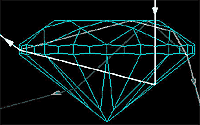
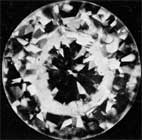
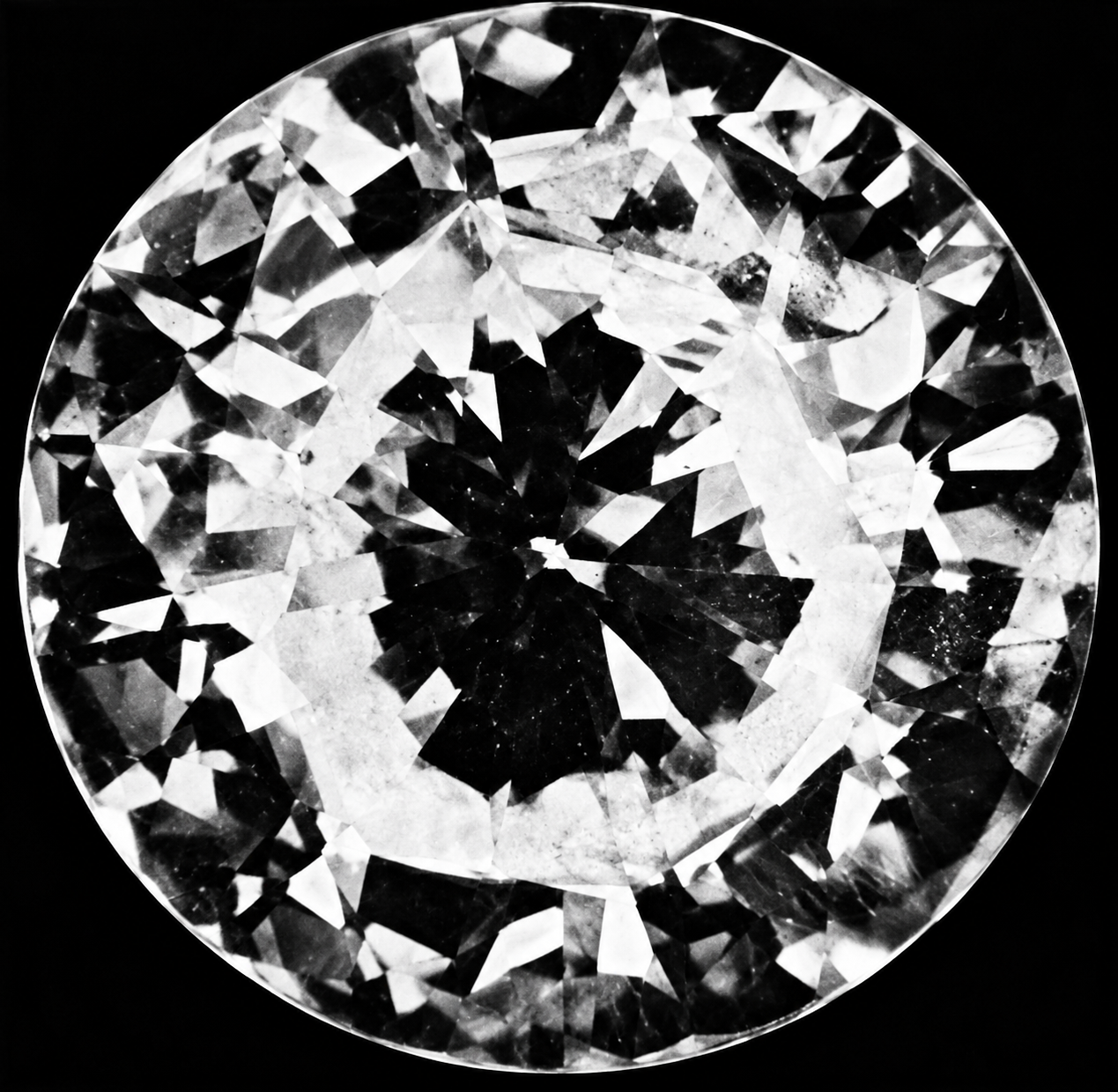
A ‘fisheye’ appears as a circular inclusion just inside the table, and in extreme examples can look like an I3 inclusion. The fisheye effect is a reflection of the girdle on the opposite side. Diamonds that display a fisheye effect are given a penalty score and a warning comment that a diamond is, or almost is, a fisheye.
Fisheyes are more apparent if the pavilion is shallow and the table is large, or a combination of the two. If the girdle is very thick and not polished (bruted) a fisheye looks far worse. HCA has no input for this information.
Fisheyes require no tilt to be seen if a diamonds pavilion is 39° and the table is 58.4%, an increase in table size to 59.4% in this example would result in a fish-eye that would be of a width of 1% of the diamonds diameter. Diamonds with deeper pavilions will still show a fisheye if the table size is large enough. For example a 41° pavilion and 72.2% table shows a fisheye. Some people are happy to accept a near fisheye because the stone will have an excellent spread. An automated comment on the cut adviser system warns a buyer if a diamond is close to showing the fisheye effect.
We may change the method of calculation to an angle based calculation. The results would be very similar.
Table 8. Fisheye penalties
| Fish - eye | Near Fish - eye | |||||
| Percentage | 0% | 1% | 2% | 3% | 4% | 5% |
| Penalty score | 1 | 0.8 | 0.6 | 0.4 | 0.2 | 0 |
| Comment | This diamond shows a fish-eye effect. Do not buy it. | A fish-eye effect is visible just under the table when viewed from a slight angle. | A fish-eye effect may be visible just under the table when viewed from an angle. | |||
Figure 19. Fish-eye ray path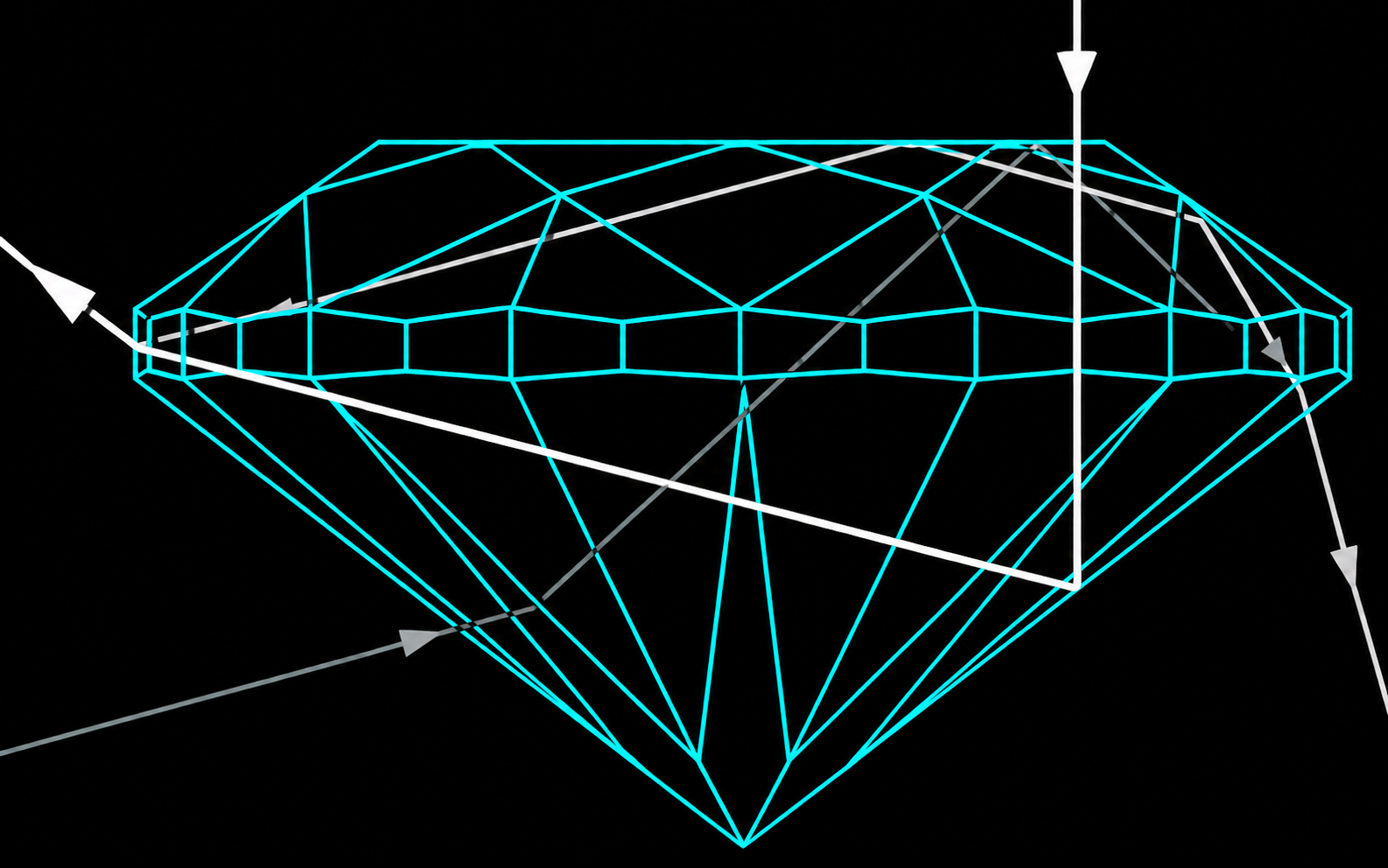 Open full-size image · View original
 Open full-size image · View original